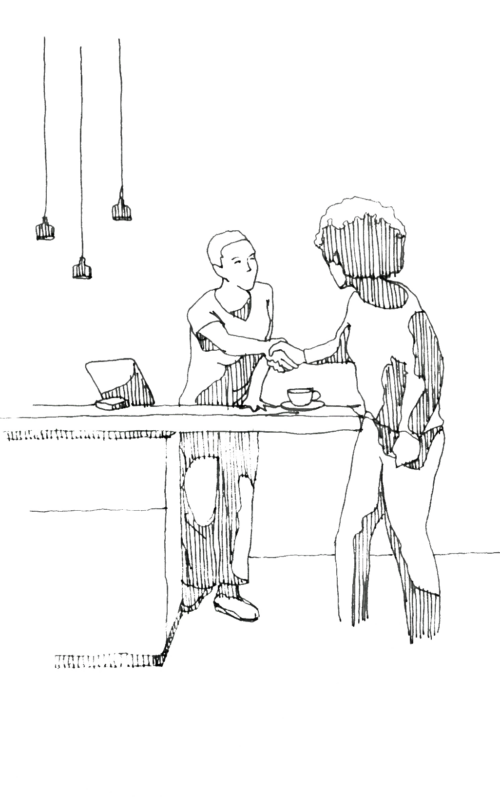
Prototyping…
Did we get the details right?
Making innovative store concepts tangible
Your ideas should take shape as quickly as possible. To this end, the design concept is translated into a technical concept.
We draft plans for furniture and installations, check each furnishing element and each material in terms of its feasibility, availability and resilience. And we make proposals to show which elements could be implemented using sustainable materials.
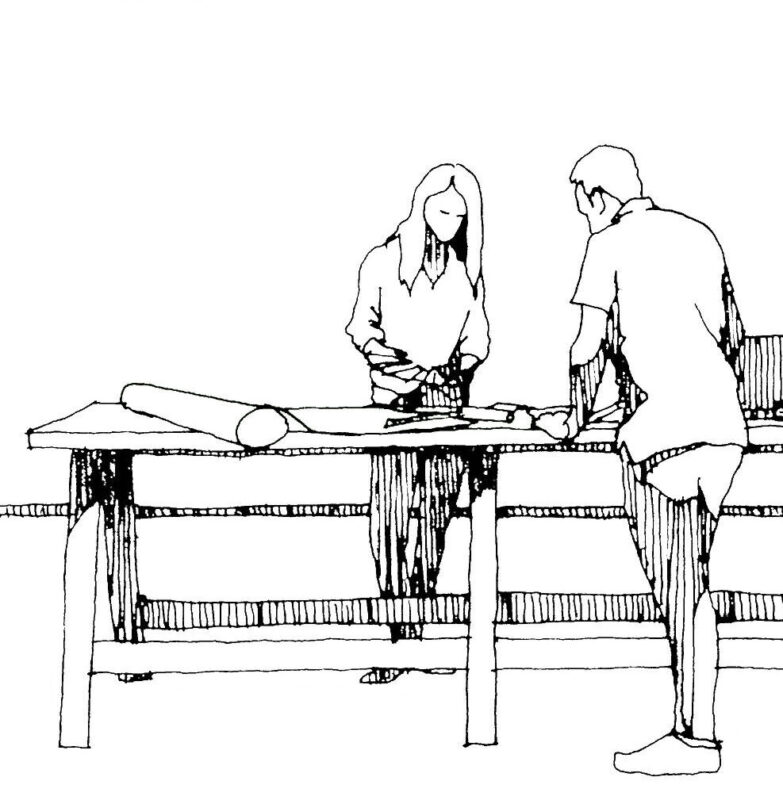
Rooms tell stories – about brands, people, and encounters.
Inspire yourself.
See how together we can create rooms that enthrall:
Breathing life into design
Technical concept
We create a well-founded overall technical concept. We align design, construction, and feasibility to achieve well-thought-out solutions.
Hand samples
The material, surface, and touch and feel determine the quality. Individual hand samples enable you to experience the details in reality and then reach well-founded decisions.
Material experiments
Discover new possibilities: Join us to test and compare various materialities, surfaces, and finishings directly in the development process.
Prototype construction
We turn ideas into real things. Our precision-manufactured prototypes make designs visible and allow them to be tested and enhanced.
Form and function tests
We test design, ergonomics, and technical perfomance in real conditions, ensuring maximum safety and optimization well ahead of serial production.
Focus on prototyping: what our team says…
Alejandra/ Technical Engineer

Product Design
„For our Design team, the prototyping space is way more than a workshop. It is where digital ideas turn into real, testable solutions. In the office, we use state-of-the-art 3D modeling to create detailed designs and work with CAD systems meeting the latest technical standards. Components, joints, and motion sequences are precisely planned, simulated, and visualized.
We perform static material calculations during this stage already to determine the load-bearing capacity, …
… maximum loads, and safety reserves with the utmost precision. This way, we can calculate how a design will behave with defined weights, for example, or specify the materials strength needed to guarantee long-term stability.
On the prototyping space, this digital planning becomes tangible reality. Here, we test the design on a 1:1 scale. Did we get the proportions and ergonomics right? Do the moving parts work as planned? Are the installation steps practical and efficient to implement?
The prototype offers crucial validation for the design. It shows directly whether our theoretical assumptions bear up in practice. We can see, for example, whether strutting is adequately dimensioned, whether we selected the tolerances correctly, or whether design details can be simplified to reduce installation time.
For us, that means that prototyping enables us to fine tune the design solution. Any adjustments made are targeted and databased before serial production begins. Enhanced technical safety, reduced development risks, optimized manufacturability, and an end product that is analyzed down to the final detail in terms of function, cost, and quality: Those are the benefits of prototyping.“
Project Management
„For us Technical Project Managers, prototyping is an absolute prerequisite for transferring a project safely and responsibly to serial production. Actually building the furniture is the only way to turn planning into a reliable basis for decisions. That means no longer just discussing concepts, …
… but actually reviewing and testing them in practice and subjecting them to targeted further development. Many challenges only emerge when the furniture is physically built: Is the order in which the furniture is installed really consistent with the planning? Have the components been constructed to avoid any collisions? Do the tolerances selected conform to practical requirements? Can the furniture be efficiently transported and installed? Just one example: You may need to see the actual furniture to notice that a joint needs amending in terms of its construction to reduce installation time or that reinforcement is needed to permanently guarantee the desired degree of stability.
The prototype reveals technical risks before they lead to cost, deadline, or quality problems in serial production. At the same time, it enables us to perform realistic stress and functionality tests and assess material and production details in real conditions.
Prototyping offers technical security, reduces reworking in serial production, and minimizes project and investment risks.
Not only that: It creates a shared understanding of the specifics within the project team and in liaison with clients. Decisions can then be based on a product tested in real conditions, rather than on drawings or assumptions.
This way, prototyping advances the project to a dependable, practice-based level and provides a firm foundation for a well-controlled, economically viable, and successful serial launch.“

Sascha / Head of Purchasing

Procurement Management
„Prototyping helps Procurement to reach a reliable basis for taking decisions. That is because the materials, components, and executions can be evaluated not just in theory, but actually tested in real conditions. Rather than relying exclusively on datasheets, samples, or photos, various solutions can be directly reviewed in practice.
Versions involving alternative materials, diverse executions, or different price-performance profiles, for example, can be …
… compared with each other. The aim is to identify the version which best satisfies both technical requirements and economic expectations.
One major advantage of prototyping is the direct benefit to the client. Sampling means that various materials, executions, and price options can be tested in practice and directly compared. This soon reveals which approach offers the best combination of quality, function, and cost. That way, prices can be optimized not merely by cutting back, but based on targeted coordination with the client’s actual needs. The outcome: a solution with a convincing price-performance profile.
For Procurement, this process also means that risks can be detected at an early stage and well-founded decisions taken before any larger-scale investments or serial orders are triggered. And this significantly reduces cost variances, quality problems, or delays further down the line during serial production.
One key source of added value is the cooperation with suppliers during the prototyping stage. In this early phase of any project, Procurement gains valuable insights into their performance capacity in terms of delivery times, production quality, flexibility in implementing adjustments, and reliable compliance with specifications. This way, we can identify stable, high-performing partners at an early stage.
Put simply, structured prototyping enables us to optimally align economic considerations with quality requirements. For clients, it leads to products that convince in terms of their functionality, are reliable to use, and at the same time offer very good value for money. In parallel, this process provides all involved with a higher degree of planning reliability and a solid foundation for a smooth serial rollout on schedule.“
Quality Management
„For Quality Assurance, the prototype offers the key foundation for verifying requirements early on in the project and safeguarding the utmost standards. During this stage, we already perform extensive electrical and safety tests to exclude any risk to users. We supplement these with structured functionality tests to guarantee faultless, reliable use in everyday operations. We conduct targeted tipping and static tests to review stability and load-bearing capacity in real conditions. We check, …
… for example, to see if a product remains stable if loaded on one side only and if it permanently meets the defined weight-bearing requirements.
Based on the specific prototype, we can also account for and transparently portray country-specific regulatory requirements, such as those governing the reliability of specific materials or national measurement and height regulations.
This way, we ensure that all relevant norms and standards are complied with well before serial production.
Early implementation of these test processes means we can detect any variances immediately, take targeted steps to minimize risks, and safeguard sustainable and safe product quality in line with the relevant norms.“

Getting physical with ideas
Matthias Hummel on prototyping in retail:
“Prototyping is at the heart of our creations.
Matthias Hummel / Managing Partner
It is where concepts take shape, visions become tangible, and ideas turn into real spaces.
If your aim is a viable and successful concept, you need prototyping!“
Focus on client projects
Some of the things we’ve tested for our customers.
Electrification of modular wall-mounted systems

Street One
The goal of the project was to develop a plug-and-play system for the electrification of modular wall-mounted systems. The aim was to provide a central power supply via a transformer for complete wall-mounted systems with a power requirement of over 600 watts.
A key component of the development was streamlined cable management: cables were to be reduced to a minimum, neatly organized, and standardized. This results in a clear, maintenance-friendly, scalable, and quick-to-install system.
In addition to reorganizing the cable management, other elements were integrated and electrified, including logos, shelves, and light boxes, which blend seamlessly into the system.
The first step involved creating a prototype, which the team used to test functions and fine-tune details. This internal testing phase allowed the system to be optimized before it was subsequently presented to the client.
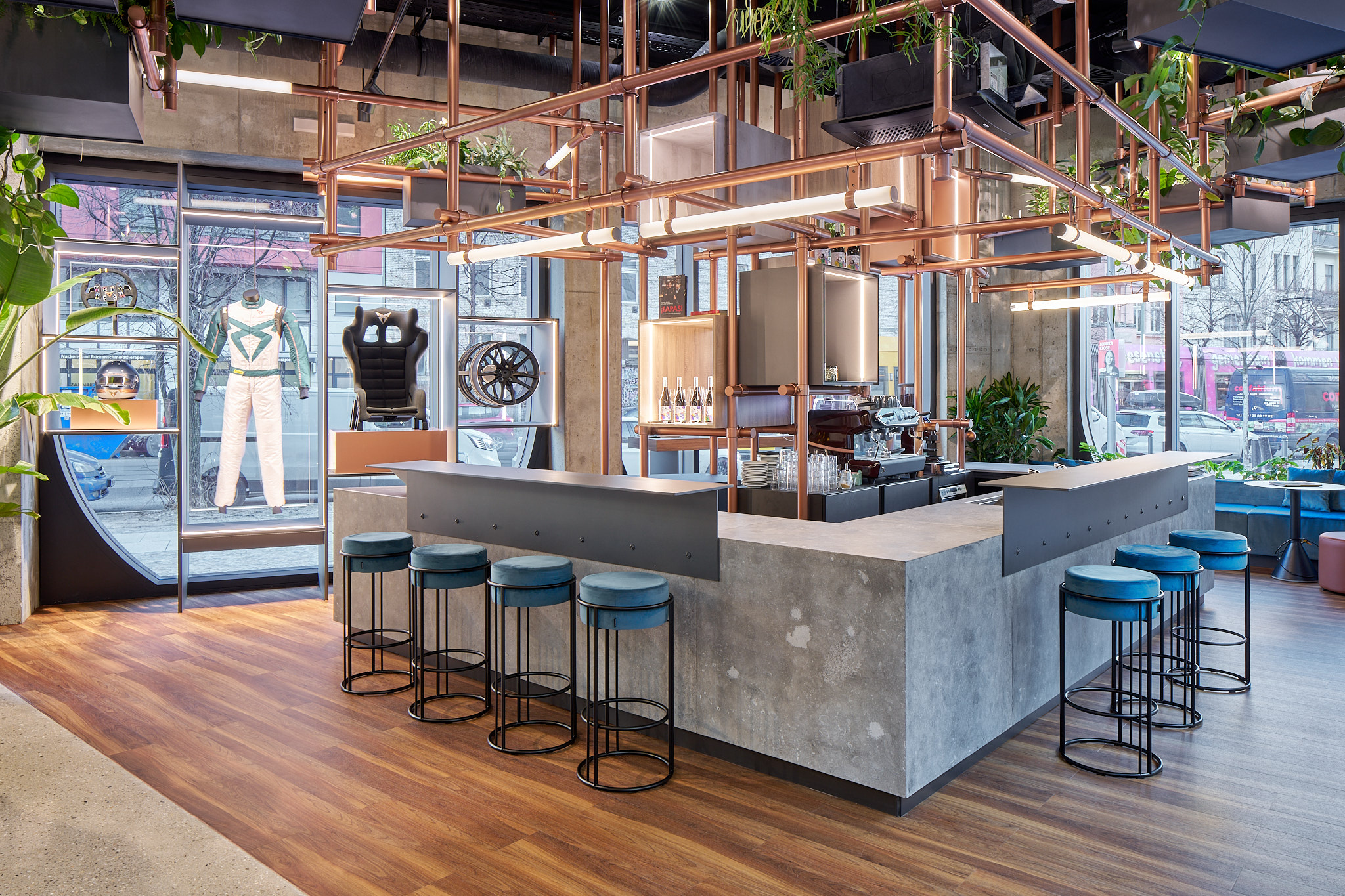
Cupra
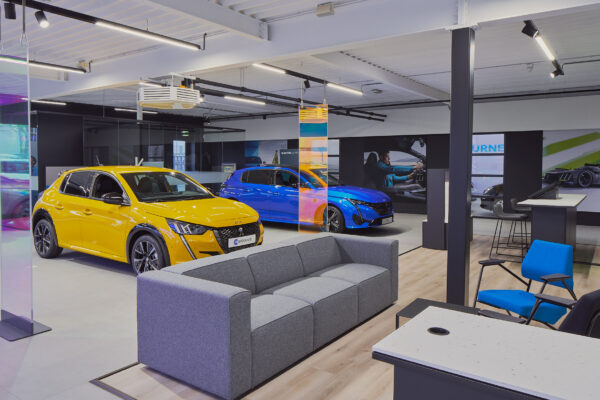
More sophisticated, youthful and closer to the lifestyle of the younger generation: three concepts are available for the perfect launch of a sporty automotive brand. In the tender stage, initial ideas for the materials to be used are only roughly defined. Vizona is quick to establish that they would not be capable of transporting the desired image.
We listen very closely and gain an understanding of the brand objectives. That helps us to flesh out ideas for the materials. And we inject real storefitting passion. We perform endless experiments in the joinery and other workshops until the CI colours and envisaged materials work for all the furniture.
And the client can examine the hand samples and convince itself up close that the colour depth and haptics really work. In addition, the showroom design scheme has to be suitable for rollout. Vizona develops prototypes for each concept and assembles three model stores for the client. These are then ready to be discussed. What works and how? Where do we need to cut costs? Which details need adjusting for larger quantities?
That is the perfect basis for deciding on the final concept! And the foundation for the pending success: together, strategy and quick thinking, marketing, store design and CI-conformity lead to a veritable explosion in the new brand.
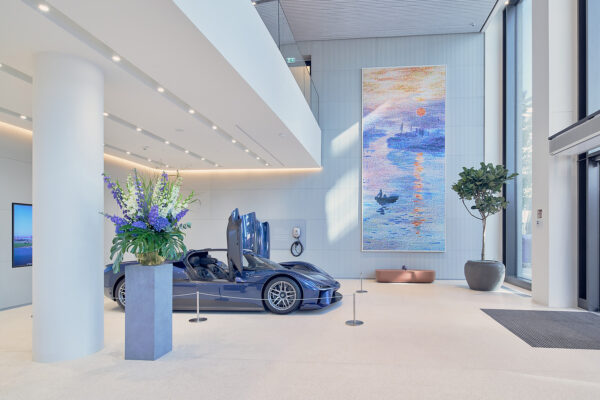
Prototyping a vehicle platform for trade show and presentation areas
BMW M
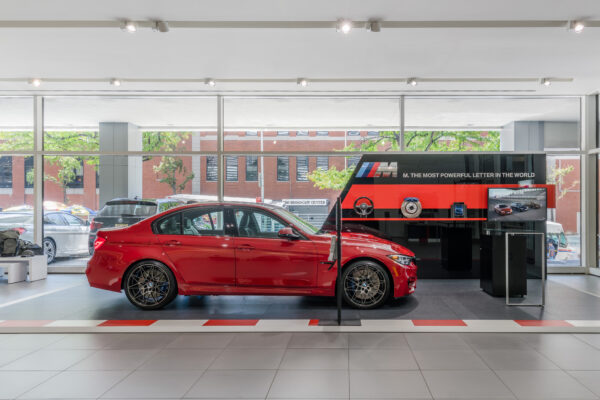
The prototype was designed to develop and validate a BMW M vehicle display platform intended for use in BMW showrooms worldwide. The platform was required not only to safely support the static load of a vehicle but, more importantly, to withstand the dynamic stresses generated when a car is driven onto it.
The complex substructure, which stabilizes the connected rear wall and ensures power supply for presentation surfaces and media installations, was also put through its paces.
To verify these requirements, a functional prototype was developed and tested under realistic conditions (with a vehicle driving onto and off the platform). At the same time, high precision in execution was achieved, particularly with regard to joint patterns and surfaces.
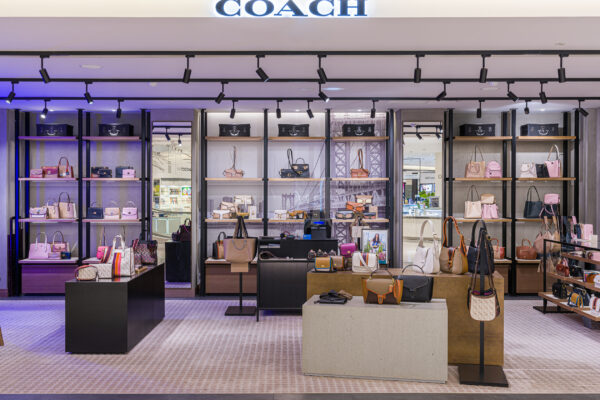
Coach
Over the course of several weeks, this project took shape through close international collaboration between Weil am Rhein and New York.
In a closely coordinated process, prototypes and material samples were continuously exchanged, tested, and refined.
All material samples and prototypes were shipped to New York and submitted there for final approval. The work was based on detailed design and drawing plans, which enabled precise coordination among all parties involved.
The manufactured prototypes were largely pre-assembled to ensure efficient further processing. Final assembly was then carried out in New York by local service partners.
On the decisive day, the pilot series inspection took place in Weil am Rhein.
The result: no further adjustments were necessary. This cleared the way for the international rollout.
Subsequently, series production began, along with delivery to the Asian market and other global locations.

FAQ-Section
Development & Prototyping helps to review a store concept technically at an early stage and make it tangible. Design ideas are translated into concrete technical solutions before they move into production or rollout. This allows materials, constructions, durability, availability and feasibility to be assessed in good time.
Vizona translates the design concept into a technical concept. This includes plans for furniture, installations and individual interior elements. Every detail is reviewed to determine whether it is technically feasible, economically viable, available and suitable for later use.
Prototyping is particularly useful when a new store concept is being developed, an existing concept is being refined or an international rollout is being prepared. Especially with new materials, complex constructions, special surfaces or high quantities, a prototype helps to review quality and function in advance.
Yes. Vizona reviews materials not only from a design perspective, but also in terms of availability, durability, processing, maintenance, cost impact and suitability for the specific application. In retail spaces, it is especially important that materials not only look good, but also perform well in everyday use.
Vizona reviews design ideas at an early stage in terms of technical feasibility, durability, material use and later application. This makes it clear which details already work, where adjustments may be useful and how a concept can be reliably transferred into the next project phase.
Vizona translates complex design ideas into technical drawings, samples, material tests or prototypes. This makes abstract concepts more concrete and easier to evaluate together with clients, design teams and other project partners.
References prototyping




Are you also in the mood for a change?
We look forward to an exchange.
Vizona GmbH
Feuerbachstraße 9
D-79576 Weil am Rhein
T +49 7621 7700 00
info@vizona.com
Vizona AG
Klünenfeldstraße 22
CH-4127 Birsfelden
T +41 61 511 7630